
The CBA Glossary
An explainer thing for the NBA's Collective Bargaining Agreement
What the salary cap and CBA are
The NBA's Collective Bargaining Agreement covers a lot of things related to the operation of the league. It is a big document, written in legal speak - across its 676 pages are 42 Articles, 17 Exhibits, countless clauses and about seventy billion words. Even the table of contents alone runs to 24 pages. The point of this website is to make that information digestible.
From the point of view of the fan, the most important (and often obvious) part of what the CBA does is legislate the management of everything to do with the salary cap. Therefore, even though it is far from the sole focus of the giant sprawling CBA document, it will be the primary focus of the CBA Glossary, and it is structured accordingly.
To begin with, then - what actually is a CBA, what is a salary cap, and how were they arrived at?
Salary cap quick facts
- Introduced
- 1984
- Type
- Soft cap
- Based on
- Basketball Related Income
- Updated
- Annually, after the moratorium audit
- Current year
- 2025-26
What the CBA is
The NBA's Collective Bargaining
Agreement (hereafter, the CBA) is a contract between the NBA and the NBA Players
Association - the union that exclusively represents the players. It is an
agreement that sets the rules and structure for how the league operates, in
a large amount of areas. ⓘArticle XXXIV (Recognition
Clause):
The NBA recognizes the Players Association as the exclusive collective bargaining
representative of all persons who are employed by NBA Teams as professional
basketball players and/or who may become so employed during the term of any
collective bargaining agreement between the parties or any extension thereof:
(a) all persons who are employed by NBA Teams as professional basketball players;
(b) all persons who have been previously employed by an NBA Team as professional
basketball players who are seeking employment with an NBA Team as a professional
basketball player; (c) all rookie players selected in each year’s NBA Draft;
and (d) all undrafted rookie players seeking employment with an NBA Team as
a professional basketball player. The Players Association warrants that it
is duly empowered to enter into this Agreement for and on behalf of such persons.
The NBA and the Players Association agree that, notwithstanding the foregoing,
such persons and NBA Teams may, on an individual basis, bargain with respect
to and agree upon the provisions of Player Contracts, but only as and to the
extent permitted by this Agreement.
From the point of view of the fan - and thus, this website - everything contained within Article VII, which details the form and function of the salary cap, is the most important thing. You are here because you want to know cap stuff, because you are a fan of NBA basketball and want to understand it better, not because you are a fan of sportspeople's pension plans and their intricate operation. [Although, if you are, hello.] The CBA is however a sprawling document, containing everything from health and safety to scheduling, from drug testing to arena signage, from the Disabled Player Exception to the player's right to use game footage of themselves on their social media feeds. It is thorough, and gets more thorough with each new deal, building on the last.
The CBA essentially exists to achieve labour peace between players and owners. Without a CBA, there have been labour lockouts (in which owners prevented players from playing), and there could also be strikes (in which players refuse to play). Having a CBA also permits certain vehicles such as the salary cap, which, without an express agreement of this nature, might run afoul of wider American labour laws.
The CBA is renegotiated every few years; the latest and current CBA went into effect on 1st July 2023. It is set to run through the end of the 2029-2030 salary cap year (30th June 2030), although it can end earlier than that under certain circumstances, explained here.
What the salary cap is
Theoretically, the salary cap is,
as the name suggests, a cap on salaries. That cap is however not inflexible.
Indeed, it is very flexible, and exploiting that flexibility is key to roster
building. ⓘArticle I (Definitions) Section
1 (Definitions) (mmm):
"Salary Cap" means the maximum allowable Team Salary for each Team for a Salary
Cap Year, subject to the rules and exceptions set forth in this Agreement.
The general trend across successive CBAs is one of adding further limitations on spending. Shorter contracts, smaller maximum increases, greater restrictions on exceptions, and financial incentives to stay cheap (more punitive luxury tax penalties, the advent of the aprons, amnesty waivers, nothing of any significant importance happening in the event that the minimum team salary is missed, etc) have all developed over the last two decades, with a view to protecting everybody. (Not least of which is protecting poorly-run teams from themselves.)
Nevertheless, the cap is here, more than four decades old, and something everyone should know about. After all, it affects every NBA roster decision. And despite the aforementioned limitations, the salary cap is going up, up, up. This is because its size is tied to the NBA's revenue, as seen below.
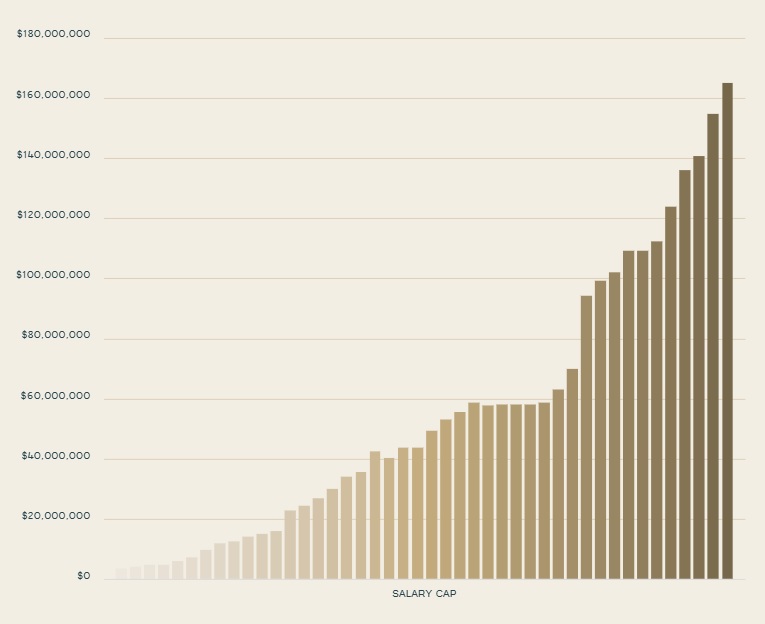
The salary cap for the 2026-27 NBA season has been set at $164,961,000.
"Hard" versus "soft"
The NBA's salary cap is what is known as a "soft" cap. This means that, while it serves as a theoretical limit on player spending, there are ways around that limit, called "exceptions". There are both enough of these, and enough reasons for teams to use them, for almost every NBA team to be over the salary cap at any given time.
The alternative to a soft cap would of course be a "hard" cap, akin to the one in the NFL. The NBA's system however is very different to that one, and results in less waiving of star players for financially-motivated reasons. And this is probably for the best.
This cap "softness" is however not invariable, as there does exist a circumstance under which a team can find itself subjected to a "hard" cap, i.e. a completely non-negotiable spending limit. This happens in the event of something known as "triggering the aprons", which sounds like a bawdy 1960s metaphor for something adults do but which is a valid concern in the world of NBA roster management. See the Aprons page for more.
A team with $20 million in cap room can sign a free agent directly with that room. A team over the cap usually needs an exception, a trade, or re-signing rights to add salary.
Basketball Related Income
Basketball-Related Income, or BRI,
is the catch-all term for the economic levers that determine the size of the
salary cap. By and large, it refers to how much money the NBA makes in operating
revenues. ⓘArticle VII (Basketball Related
Income, Salary Cap, Minimum Team Salary, Tax Level, Apron Levels, And Designated
Share Arrangement), Section 1 (Definitions) (a) (Basketball Related Income)
1:
“Basketball Related Income” (“BRI”) for a Salary Cap Year
means the aggregate operating revenues (including the value of any property
or services received in any barter transactions), accounted for in accordance
with Section 1(b)(1) below, received or to be received for or with respect
to such Salary Cap Year by the NBA, NBA Properties, Inc., including any of
its subsidiaries whether now in existence or created in the future (hereinafter,
“Properties”), NBA Media Ventures LLC (“Media Ventures”),
any other entity which is controlled, or in which at least fifty percent (50%)
of the issued and outstanding ownership interests are owned, by the NBA, Properties,
Media Ventures, and/or a group of NBA Teams (hereinafter, “League-related
entity”) (but excluding the amount of such League-related entity’s
revenues equal to the portion of its total revenues that is proportionate
to the share of the entity’s profits to which ownership interests not
owned by the NBA, Properties, Media Ventures and/or a group of NBA Teams are
entitled), all NBA Teams other than Expansion Teams during their first two
(2) Salary Cap Years (but including the Expansion Teams’ shares of national
television, radio, cable and other broadcast revenues, and any other League-wide
revenues shared by the Expansion Teams, provided such revenues are otherwise
included in BRI) and Related Parties (in accordance with Section 1(a)(7)(i)
below), from all sources, whether known or unknown, whether now in existence
or created in the future, to the extent derived from, relating to, or arising
directly or indirectly out of, the performance of Players in NBA basketball
games or in NBA-related activities. For purposes of this definition of BRI:
(x) “operating revenues” shall include, but not be limited to, any
type of revenue included in BRI for the 1995-96 and 1996-97 Salary Cap Years
(without regard to whether such type of revenue is received on a lump-sum,
non-recurring or extraordinary basis, but subject to any specific rules set
forth in this Article VII relating to the recognition or amortization of such
amounts); and (y) “Player” means a person: who is under a Player
Contract to an NBA Team; who completed the playing services called for under
a Player Contract with an NBA Team at the conclusion of the prior Season;
or who was under a Player Contract with an NBA Team during (but not at the
conclusion of) the prior Season, but only with respect to the period for which
he was under such Contract. Subject to the foregoing, BRI shall include, but
not be limited to, the following revenues:
[insert 34 more pages of details]
To define BRI more precisely in this space would be counter-productive, as the CBA itself devotes 34 pages to it. [Pp. 131-165; Article VII Section 1(a), if you're keen.] To summarise, however, BRI is broadly made up of:
● Gate receipts, including exhibitions and postseason ⓘArticle VII (Basketball Related Income, Salary Cap, Minimum Team Salary, Tax Level, Apron Levels, And Designated Share Arrangement), Section 1 (Definitions) (a) (Basketball Related Income) 1:
(i) Regular Season gate receipts (or practice facility NBA-event receipts), net of applicable taxes, surcharges, imposts, facility fees, and other charges (including, without limitation, charges related to arena financings) imposed by governmental or quasi-governmental agencies other than income taxes (collectively, "Taxes"), and net of all reasonable and customary Team and Related Party ticket-related expenses and premium seating ticket expenses related thereto, subject to the provisions of Section 1(a)(6) below, including, without limitation, gate receipts received or to be received by a Related Party in accordance with Section 1(a)(7)(i) below, including: (A) the value (determined on the basis of the price of the ticket) of all tickets traded by a Team for goods or services; and (B) the value (determined on the basis of the League-wide average ticket price for "Non-Season Tickets") of all tickets for Regular Season games provided by a Team on a complimentary basis, without monetary or other compensation to a Team including complimentary admission to luxury suites (including standing room only tickets and tickets provided to Team employees other than Players); provided, however, that (x) the value of the "Excluded Complimentary Tickets" with respect to all Regular Season games in a Season shall be excluded from BRI, and (y) in addition, tickets provided as part of sponsorships and other transactions, where the proceeds from such transactions have been included in BRI, shall not be included in determining the number of complimentary tickets in any Season. For purposes of the foregoing, (1) "Non-Season Tickets" shall mean only single-game tickets and tickets sold in packages covering fewer than fifty percent (50%) of a Team's Regular Season home games and (2) "Excluded Complimentary Tickets" shall mean (a) 2.1 million tickets for each Season during the term of the Agreement, subject to increase pursuant to the following sentence, and (b) any tickets provided on a complimentary basis to or on behalf of Players. If, in any Salary Cap Year after the 2023-24 Season, the ratio of tickets sold to Regular Season home games (including contractually delivered sponsorship and trade tickets) is less than eighty percent (80%) of the seating capacity for those Regular Season home games, then the number of Excluded Complimentary Tickets for that Salary Cap Year shall be increased by a number equal to (x) the difference between eighty percent (80%) and the actual ratio of tickets sold to seating capacity, multiplied by (y) 2.1 million tickets. By way of example, if the actual ratio of tickets sold to seating capacity in the 2024- 25 Season were seventy-nine percent (79%), then Excluded Complimentary Tickets would increase by 21,000 tickets (i.e., (80% - 79%) * 2.1 million) for the 2024-25 Salary Cap Year [...]● Season ticket sales ⓘArticle VII (Basketball Related Income, Salary Cap, Minimum Team Salary, Tax Level, Apron Levels, And Designated Share Arrangement), Section 1 (Definitions) (a) (Basketball Related Income) 1:
(i) Regular Season gate receipts (or practice facility NBA-event receipts), net of applicable taxes, surcharges, imposts, facility fees, and other charges (including, without limitation, charges related to arena financings) imposed by governmental or quasi-governmental agencies other than income taxes (collectively, "Taxes"), and net of all reasonable and customary Team and Related Party ticket-related expenses and premium seating ticket expenses related thereto, subject to the provisions of Section 1(a)(6) below, including, without limitation, gate receipts received or to be received by a Related Party in accordance with Section 1(a)(7)(i) below, including: (A) the value (determined on the basis of the price of the ticket) of all tickets traded by a Team for goods or services; and (B) the value (determined on the basis of the League-wide average ticket price for "Non-Season Tickets") of all tickets for Regular Season games provided by a Team on a complimentary basis, without monetary or other compensation to a Team including complimentary admission to luxury suites (including standing room only tickets and tickets provided to Team employees other than Players); provided, however, that (x) the value of the "Excluded Complimentary Tickets" with respect to all Regular Season games in a Season shall be excluded from BRI, and (y) in addition, tickets provided as part of sponsorships and other transactions, where the proceeds from such transactions have been included in BRI, shall not be included in determining the number of complimentary tickets in any Season. For purposes of the foregoing, (1) "Non-Season Tickets" shall mean only single-game tickets and tickets sold in packages covering fewer than fifty percent (50%) of a Team's Regular Season home games and (2) "Excluded Complimentary Tickets" shall mean (a) 2.1 million tickets for each Season during the term of the Agreement, subject to increase pursuant to the following sentence, and (b) any tickets provided on a complimentary basis to or on behalf of Players. If, in any Salary Cap Year after the 2023-24 Season, the ratio of tickets sold to Regular Season home games (including contractually delivered sponsorship and trade tickets) is less than eighty percent (80%) of the seating capacity for those Regular Season home games, then the number of Excluded Complimentary Tickets for that Salary Cap Year shall be increased by a number equal to (x) the difference between eighty percent (80%) and the actual ratio of tickets sold to seating capacity, multiplied by (y) 2.1 million tickets. By way of example, if the actual ratio of tickets sold to seating capacity in the 2024- 25 Season were seventy-nine percent (79%), then Excluded Complimentary Tickets would increase by 21,000 tickets (i.e., (80% - 79%) * 2.1 million) for the 2024-25 Salary Cap Year [...]● Revenues from broadcast rights
● Game night sales ⓘArticle VII (Basketball Related Income, Salary Cap, Minimum Team Salary, Tax Level, Apron Levels, And Designated Share Arrangement), Section 1 (Definitions) (a) (Basketball Related Income) 1:
(v) All proceeds of any kind, net of reasonable and customary expenses (including Taxes) related thereto, subject to the provisions of Section 1(a)(6) below, from: (A) in-arena (or in practice facility) sales of novelties and concessions (including revenues derived from the sale of novelties and concessions: (1) during (and immediately preceding or after) the Team's games or other public Team events at the arena (or practice facility), from carts and kiosks or other similar sales locations that are only operated on an intermittent basis (i.e., principally when an NBA, NHL, or other public event is being held at the arena (or, respectively, the practice facility)) or from restaurants that are only operated on an intermittent basis (i.e., principally when an NBA, NHL, or other public event is being held at the arena (or, respectively, the practice facility)), in (i) the arena plaza or elsewhere on the immediate perimeter of the arena (or, respectively, the practice facility), or (ii) directly across the street from the arena (or, respectively, the practice facility); and (2) from Team-organized viewing parties of NBA games held in any location), (B) sales of novelties and concessions in Team-identified stores located within such radius of the Team's home arena as is permitted by the NBA, (C) NBA game (or practice facility NBA-event) parking and programs, (D) Team sponsorships (whether or not the proceeds are directly or indirectly donated to charity), (E) Team promotions, (F) temporary arena signage (as defined in Section 1(a)(1)(vi) below), (G) arena club revenues, (H) summer camps, (I) non-NBA basketball tournaments, (J) mascot and dance team appearances, (K) the sale of the right to pour beverages or (except as provided in Section 1(a)(2)(xx) below) to provide concessions, (L) sales of jersey patch rights, and (M) other practice facility events to the extent such proceeds would be included in BRI if the event occurred in the Team's home arena, in each case, to the extent that such proceeds are related to the performance of Players in NBA basketball games or NBA-related activities, including, without limitation, such proceeds received or to be received by a Related Party (in accordance with Sections 1(a)(1)(vi) and 1(a)(7)(i) below). For the purposes of clarity, "Team-identified stores" includes stores owned by Teams or Related Parties that sell predominately Team-branded merchandise, whether or not the store is Team-identified [...]● Championship parade revenues
● 50% of arena naming rights (including practice facilities), luxury suites, fixed arena signage revenues and corporate sponsorship areas
● And a whole lot more.
(There is an entire page of the CBA's BRI section dedicated to defining under what criteria signage in an arena car park counts as fixed or not. That's how precise and esoteric the CBA can be, particularly the BRI bit. At some point in this website's future, there will follow a complete breakdown, but it is not a priority today.)
While the details generally do not matter to fans, the broad concept of BRI does, because even if the details are too arcane (and too private) to be of much import to the outsider, BRI defines the salary cap.
Relationship between BRI and the salary cap
The NBA's salary cap for each season
is set at an oddly precise 44.74% of projected BRI for that salary
cap year, minus projected benefits, divided by the number of teams. One caveat
to the "number of teams" parameter is that expansion teams are not
included in that total for their first two seasons of existence. ⓘArticle
VII (Basketball Related Income, Salary Cap, Minimum Team Salary, Tax Level,
Apron Levels, And Designated Share Arrangement), Section 2 (Salary Cap, Minimum
Team Salary, Tax Level, Apron Levels, and Draft Pick Penalty) (a) (Calculation
of Salary Cap, Minimum Team Salary, Tax Level, and Apron Levels):
For each Salary Cap Year during the term of this Agreement, there shall be
a Salary Cap. The Salary Cap for each Salary Cap Year covered by the Term
of this Agreement will equal forty-four and seventy-four one hundredths percent
(44.74%) of Projected BRI for such Salary Cap Year, less Projected Benefits
for such Salary Cap Year, divided by the number of Teams scheduled to play
in the NBA during such Salary Cap Year, other than Expansion Teams during
their first two (2) Salary Cap Years in the NBA.
As you would expect, the definition
of "projected BRI" is long and garrulous. It too will be broken
down on the BRI page at some point. ⓘArticle
VII (Basketball Related Income, Salary Cap, Minimum Team Salary, Tax Level,
Apron Levels, And Designated Share Arrangement), Section 1 (Definitions) (c)
(Projected BRI):
“Projected BRI” for a Salary Cap Year means the amount determined
as follows: Prior to the start of each Salary Cap Year, the NBA and the Players
Association shall meet for the purpose of agreeing upon Projected BRI for
that Salary Cap Year. In the absence of an agreement of the parties otherwise
on or prior to the last day of the Moratorium Period of the applicable Salary
Cap Year, Projected BRI for such Salary Cap Year shall be the sum of amounts
determined in accordance with the following: (1) With respect to BRI sources
other than national broadcast, national telecast or network cable television
contracts, Projected BRI shall include BRI for the preceding Salary Cap Year,
increased by four and one-half percent (4.5%). For purposes of this Section
1(c)(1), a contract between or among any League-related entities and/or Teams
shall not be considered national broadcast, national telecast or network cable
television contracts. (2) With respect to national broadcast, national telecast
or network cable television contracts including the NBA/ABC agreement dated
October 3, 2014 (“NBA/ABC Agreement”) (a copy of which has been
provided to the Players Association) and the NBA/TBS 168 Article VII agreement,
dated October 3, 2014 (“NBA/TBS Agreement”) (a copy of which has
been provided to the Players Association), and national broadcast, national
telecast or network cable television contracts covering Seasons that succeed
the Seasons covered by the NBA/ABC and NBA/TBS Agreements (“Successor
Agreements”) (copies of which shall be provided to the Players Association
within ten (10) days of execution), Projected BRI for a Salary Cap Year shall
include (i) the rights fees or other non-contingent payments stated in such
contracts with respect to the Season covered by such Salary Cap Year (as such
rights fees or non-contingent payments may be adjusted by agreement of the
parties to such contracts); (ii) the amounts of revenue sharing proceeds,
if any, that are includable in BRI for such Salary Cap Year pursuant to Section
1(a)(8) above; (iii) the amounts with respect to contingent payments (other
than revenue sharing proceeds), if any, attributable to Salary Cap Years covered
by this Agreement in Successor Agreements as such amounts are agreed upon
by the parties, or if the parties do not reach agreement, by the Accountants;
and (iv) the amount included in BRI for the preceding Salary Cap Year with
respect to the value of advertising or promotional time provided to the NBA
as part of the NBA/ABC and NBA/TBS Agreements (or any Successor Agreements)
that is used for any purpose other than those listed in Sections 1(a)(1)(ii)(A)-(D).
(3) In no event shall the same amounts be included in Projected BRI or Interim
Projected BRI, directly or indirectly, more than once (including in the event
that the terms of any Successor Agreements would cause the same amounts to
be indirectly included in Projected BRI or Interim Projected BRI for a Salary
Cap Year pursuant to both subsections (1) and (2) above), the purpose of this
provision being to preclude the double-counting of amounts in the calculation
of Projected BRI or Interim Projected BRI, whether in the same or in multiple
Salary Cap Years.
Because it is tied to revenues,
which are forever in a state of flux, the salary cap (both actual and projected)
is almost never the same from year to year, and because revenues are forever
growing, the direction of travel is always upwards. It is however important
to note that, under more recent CBAs, the NBA's salary cap cannot go
down. it used to be the case that the cap would almost never go down due the
constant growth in revenue, and thus rise by circumstances than by rule; however,
as of the 2023 CBA, it is now expressly impossible for the salary cap to ever
go down in value. In the event that revenues decrease and the calculation
for a future salary cap season would mean a lower salary cap, the CBA expressly
forbids the cap - and by extension the other thresholds calculated as a percentage
of it, i.e. the luxury tax, aprons
and minimum team salary - from
being lower than the previous year. ⓘArticle
VII (Basketball Related Income, Salary Cap, Minimum Team Salary, Tax Level,
Apron Levels, And Designated Share Arrangement), Section 2 (Salary Cap, Minimum
Team Salary, Tax Level, Apron Levels, and Draft Pick Penalty) (a) (Calculation
of Salary Cap, Minimum Team Salary, Tax Level, and Apron Levels):
(6) Notwithstanding anything to the contrary in Sections 2(a)(1)-(5) above,
in no event shall any of the Salary Cap, Minimum Team Salary, Tax Level, First
Apron Level, or Second Apron Level for a Salary Cap Year (a) decrease to an
amount that is less than its amount for the immediately preceding Salary Cap
Year, or (b) increase to an amount that exceeds one hundred ten percent (110%)
of its amount for the immediately preceding Salary Cap Year.
It also can now only go up by a certain amount. The salary cap has a capped maximum increase of 110% of the previous season's amount. If the salary cap for one season is $100 million, therefore, the next season's one will be somewhere between $100 million and $110 million, depending on BRI - but not more or less, even if the revenues skyrocket/plummet. There have been much greater percentage jumps than this in the past, but the 110% rule makes for smoother long term projections.
For the life of this CBA, the NBA's salary cap amount cannot go down.
MAIN TAKEAWAYS:
- The Collective Bargaining Agreement is a deal between the league and the Player's Association on hundreds of different aspects of the league, including everything to do with salaries and the salary cap.
- A salary cap exists, but it is "soft", and has allowable exceptions.
- The amount of the salary cap each season is tied to the amount of money that the NBA generates.
- Because revenues only ever seem to go up, so does the cap. Indeed, under the current CBA, the salary cap is not allowed to go down.
- If ever revenues did crater, this CBA would likely be terminated.